Robovision AI 5.12 release notes
Release date: February 4, 2026
What's new
Hub-agent topology
Robovision AI now supports a hub–agent topology that organizes hubs and agents into a clear hierarchical structure. This topology provides improved visibility into agent connectivity and inference activity, enables better separation of environments, and makes large or distributed deployments easier to manage and maintain. See Hub-agent topology.
Building on the new hub–agent topology, you can now push inference setups from the hub to one or multiple agents. This allows process engineers to centrally prepare inference configurations, distribute them across agents, and start them later when needed—improving control, scalability, and operational flexibility in distributed deployments. See Export inference setup to agents.
DINOv3 few-shot segmentation
DINOv3 few-shot segmentation is now available, enabling robust segmentation with limited labeled data and improved cross-domain generalization. See DINOv3 few-shot segmentation tutorial.
Multiview instance segmentation (Center picking and grading)
We’ve introduced a new project type for multiview instance segmentation, designed for center picking and grading use cases. Along with this feature, we now support multi-camera configurations, enabling synchronized, calibrated cameras to work together for accurate object center localization and reliable picking or sorting across multiple viewpoints. This project type is ideal for dynamic environments such as conveyors or pallets, where precise localization, full object visibility, and consistent detection accuracy are critical. For a step-by-step tutorial, see Multiview center picking and grading solution.
Support for GenICam-compliant cameras
Starting with version 5.12, Robovision AI supports GenICam-compliant cameras, enabling seamless communication with compatible devices without the need for custom drivers or device-specific integrations.
Note
Robovision AI currently supports only Basler cameras from the GenICam family.
Dataset export
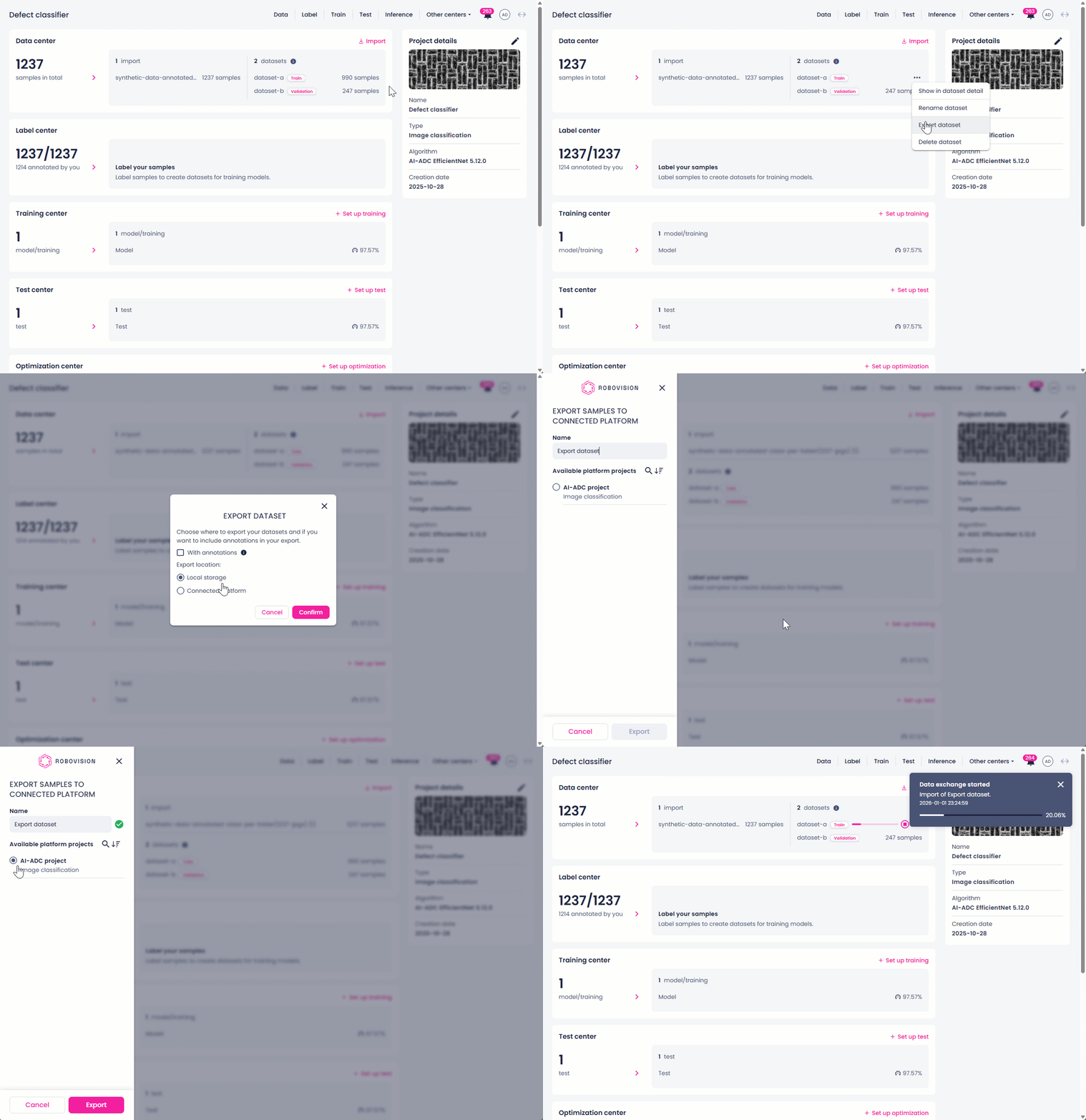
You can export your datasets to local storage or to a connected Robovision AI platform. When exporting samples without annotations to local storage, they are now saved as TIFF files. In all other cases, samples are exported in the platform’s native format. See Export datasets.
Copying and replacing annotations
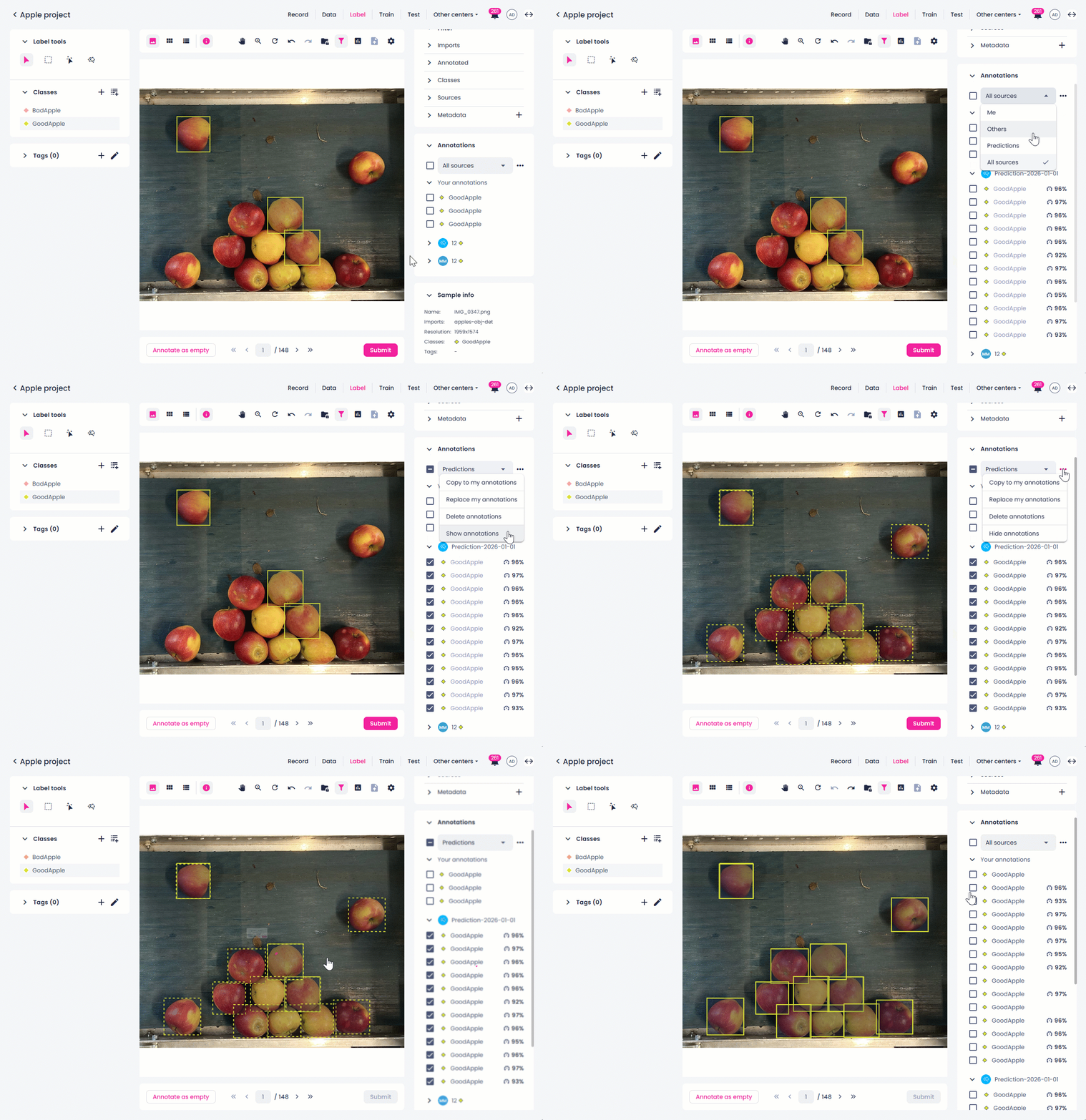
You can now copy annotations from another source or replace them. To streamline this process, we’ve made source filtering clearer and more explicit, allowing you to choose exactly what to copy or replace. See Copy or replace labels.
Thumbnail display in label center
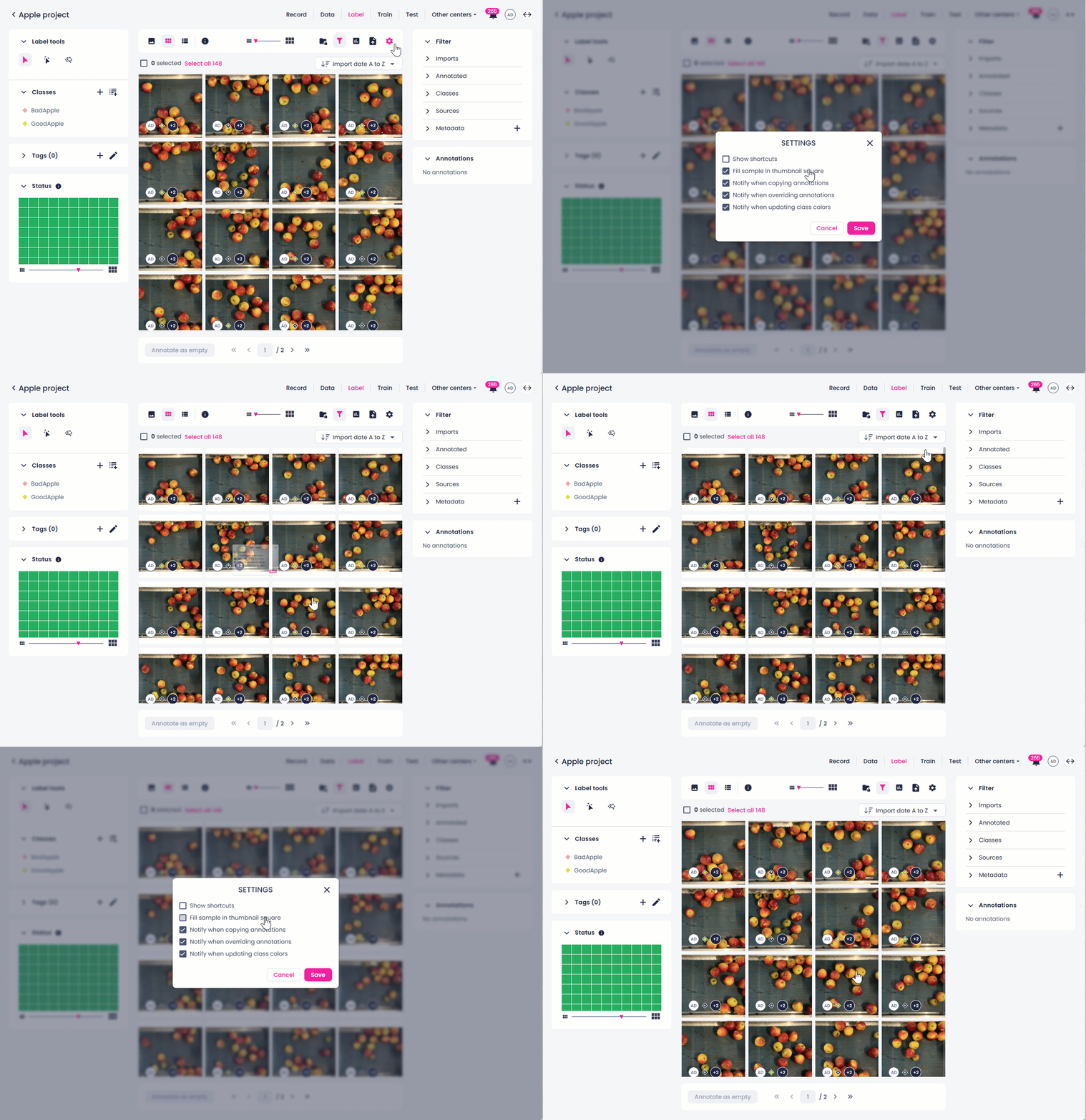
You can now control how images are displayed during labeling using the new Fill sample in thumbnail square setting. Toggle it on to fill the thumbnail with a square center crop, or turn it off to preserve the image’s original aspect ratio. This setting applies to both the thumbnail and strip views of the label center.
On-prem air-gapped installation and upgrade
- Logical Volume Management (LVM) was introduced to remove dependency on physical disk structures and enable future storage expansion with any number of NVMe or SSD disks.
- Encryption at rest was enabled for the data logical volume to improve data security.
- The underlying operating system has been changed from Ubuntu 22 to Debian 12.
Other improvements
- A new testing API endpoint is available for calibration and camera inference, enabling manual triggering and validation, and is exposed only when the API signal trigger mode is selected during camera configuration.
Bug fixes
Train center
- The issue preventing users from starting an inference process from the train center when another inference was running has been fixed. The Use for inference button is now enabled, allowing multiple inferences to run within one project.
Test center
- Before, an unclear error message (Unexpected response: 400 (Bad Request)) appeared when running a test on a dataset after removing an import. The message is now clear and explains the actual problem.
Cameras and camera configurations
- Before, a camera that had been replaced in a camera configuration could not be deleted. Now, the camera can be deleted correctly once it is no longer attached to any configuration.
Other fixes
- The issue where users could not log in after a node reboot due to an authentication service connection problem was fixed.
Known limitations
General
- The Robovision AI UI has been optimized for the browser size of 1920x1200.
- It is not possible for users to duplicate a tab if the environment is using the HTTP protocol. This does not affect environments using HTTPS. As a workaround, do one of the following:
- Open multiple browser windows instead of duplicating tabs.
- In Chrome, configure the HTTP URL to be treated as secure via
chrome://flags.
- If the storage is full, some functions may become unavailable, for example, saving annotation or training a model.
- Upgrades are supported up to two minor versions forward from your current version.
- When upgrading to a new version, new algorithm versions are installed, while preserving the existing ones. Existing projects will be updated to utilize the new algorithms.
- If the terms and conditions change, you will not be prompted to read and accept them again.
-
Notifications may be missing in specific cases, such as:
- When copying of annotations fails because the storage is almost full.
- When an inference setup import fails due to nearly full storage.
-
When recovering from an invalid or expired license, a 404 page may appear. To resolve the issue: Log out and log back in to refresh your licensing information.
Browser support
- The Robovision AI platform has been designed and validated for Google Chrome 117 or later.
- You can transfer data between Robovision AI platforms only in Chromium-based browsers (Google Chrome, Microsoft Edge, and more).
- In Google Chrome, training metrics and a final validation score might not be displayed if an ad blocker is used. To prevent this, mark the Robovision AI URL as trusted in the Google Chrome settings.
- In Google Chrome, the thumbnail view can load slowly if you have password managers like Lastpass activated. To prevent this, disable the extension or work in a guest profile window.
Backward compatibility
- Backward compatibility with Robovision AI versions 3.x and 4.x is not foreseen. But upon request, Robovision will provide the needed assistance and conversion scripts.
Branding and brand assets
- Upon upgrading to a newer version, Robovision AI may include new UI text that has not been customized. To ensure alignment, export the template containing the UI text and review for any necessary updates (see step 3 in Change brand assets).
Data recording
- Samples recorded while the recording session is stopping are missing from the recording session logs.
Data upload
- In general and with respect to the model testing functionality, the following image types are supported: JPG, JPEG, PNG, 8-bit TIF and TIFF, BMP, GIF, including a 4th transparency channel. EXIF orientation metadata is supported.
- File names must contain only Latin (ASCII) characters. There are known rendering, packing, and backup/restore issues with file names/object keys that contain non-Latin characters.
- You will be logged out of the platform if your data import has been in the Uploading stage for more than an hour.
- Limited functionality projects: You can still import data if the label center is empty.
Data center
- When the number of imports exceeds 2,500, the imports page in the data center may experience slow loading times. Removing unnecessary imports can help improve performance.
Labeling
- 2D labeler performance (in particular the Magnetic lasso and Grab cut tools) may degrade for high-resolution images.
-
You may face the following issues when using the Prediction tool in the label center:
- The prediction process gets hidden if you leave the label center. To view it again, click the Prediction tool.
- The predicted labels are not added to the samples as the prediction process is running.
- The Status section is not updated as the prediction process is running.
-
When copying or replacing annotations for multiple samples, the same source should be selected for each sample (for example, annotations from one particular member or one prediction job).
- EfficientNet: When you re-annotate already annotated samples in bulk, you will not be notified that existing annotations will be overwritten.
Pagination
- In all views except the single view, a maximum of 100 samples is displayed per page. If you select samples and then go to another page, these samples will no longer be selected.
- In the test center, you can't select samples beyond the current page (more than 100 samples). The same applies when you view samples in a dataset.
Classes
- In the label center, it is possible to create a class with a name that is just a space.
- The class name is not saved if you collapse the Classes section without pressing Enter.
Charts
-
Class distribution:
- Label and test centers: If you apply a filter when the chart is already open, the filter isn't considered. To refresh the chart, click Clear in the upper-right corner of the Chart setup panel, and then set up the chart again.
-
Confusion matrix:
- In both the UI and exported CSV files, percentages are rounded to whole numbers.
-
Label center:
- If you apply a filter when the chart is already open, the filter isn't considered. To refresh the chart, click Clear in the upper-right corner of the Chart setup panel, and then set up the chart again.
- When you generate the chart for filtered data, some information in the chart might be inaccurate.
-
Test center:
- YOLOv8+: For some samples, no model annotations are displayed in the chart, even though the annotations exist.
- The chart doesn't consider the filters you have applied—the number and percentage of samples labeled with a certain class is incorrect. To view the actual number of samples, you'll need to click the needed cell.
-
Wafer map:
- The wafer map chart is optimized for the browser size of 1920x1080 in full-screen mode. To enter full-screen mode, press F11.
- When the wafer map contains more than 100,000 samples, selection and filtering within the chart may affect performance and increase the loading time.
Model training
- DINOv3: An out-of-memory (OOM) error can occur during the training process. For recommendations on how to mitigate it, see Troubleshoot out-of-memory issue.
- PIDNet: When labeling a consistent area with the ignore class, the model might predict every class in those areas. To avoid this, ensure there is some variation in the areas labeled as ignore.
- PIDNet: If the entered batch size is too large, no validation message is displayed, and the training cannot be started.
- YOLOv8+: Subtle differences in score calculations during model validation and in the test center may result in discrepancies between the scores, even when using the same settings and data.
- During training setup, the Add model button is enabled even if there are no models available for transfer learning.
Model testing
- If you test a model on tagged data without comparison, the test data in the test center may disappear after you unassign that tag. However, the training center will still display the correct number of samples used in the test.
- Filtering is based on predicted classes from the first model only—not ground truth or second model predictions.
-
Tests may fail if:
- The test name contains exactly 255 characters.
- The test dataset has been deleted.
- You set the confidence threshold to 1 for both models when testing on tagged or imported data. The system requires at least one predicted example to compute metrics.
-
When a user tests a model on a dataset from which samples were deleted, the test runs without errors and evaluation metrics are correctly calculated and displayed on the project details page and in the training center. However, the test results are not displayed in the test center.
- When you export test results, the name of the CSV file contains the project and test names from the time the test was run.
-
DINOv3 memory constraints and performance impact:
- Enabling upsampling, especially on large images, can lead to failing tests due to excessive memory usage.
- Including a large number or high-resolution masks in the support set may exceed memory limits, leading to test failures.
- Prediction time increases proportionally with both the quantity and size of masks included in the support set.
Cameras and camera configurations
- An edited camera configuration needs to be re-applied in an inference setup. To use the updated camera configuration, edit your inference and re-apply the configuration.
Inferences
- You can't rename a running inference. Wait for the inference to stop or stop it manually before renaming.
- If you stop an inference within the first minute of this first run, inference logs will not be available.
- It is possible to delete a stopping inference from the project details page.
- You cannot restart inferences in the Failed status. To proceed, stop the inference and start it again.
- In an inference setup, repeatedly switching between imported models and then saving the setup may cause the platform to crash.
- If your license expires, you cannot access the inference center to view details of inferences started while the license was active. Renew the license to regain access.
-
Inference monitoring:
- Opening a project with limited functionality from the Inference monitoring page results in an error. To open the project, go to the Projects module and search for the project directly.
- On the Inference monitoring page, the same inference metric type may be listed multiple times. This can occur after an upgrade when projects are updated to the new algorithm version, so both the old and new versions of the algorithm remain on the platform.
- Started inference appears as hidden on the Inference monitoring page. To make the inference visible, click the eye icon.
-
Cemera inference: If a camera configuration is initially created using the camera config trigger mode and later updated to API signal trigger mode, the testing API endpoint link does not appear.
Exporting inference setup to agents
- In the Start inference setup sidebar on the Topology page, the inference time updates continuously. This timestamp reflects the last update received by the hub from the agent (sent every 3 seconds).
- Camera inference setups cannot be started on the agent from the hub. If the setup does not include camera configuration, it can be pushed and started, but the inference status will be Failed inference.
Import and export of data
- If the import or export process is interrupted, it will restart from the beginning instead of resuming, potentially resulting in multiple notifications about the process start.
-
Data transfer from connected Robovision AI platform:
- On the target Robovision AI platform, you won't receive notifications about data upload.
- On the project details page of the target Robovision AI platform, you can't stop the data upload.
- Exporting large numbers of samples to the connected platform may fail. To avoid this, export no more than 200,000 samples at a time.
- If the bandwidth is below 8 Mbit, the export to the connected platform may fail.
- If you delete an import while it's still in progress, some imported samples may not be deleted. These samples will appear in the label center, but they won't be associated with any import.
- EfficientNet: During samples export, some samples may incorrectly show empty annotations. Once the data transfer is complete, the annotations will be updated, and the issue will no longer appear.
- When data upload is in progress, the number of samples displayed above the sample preview in the label center may be out of sync with the number shown in the Imports group of the Filter panel.
-
Inference setups:
- Imported models aren't displayed on the training details page and the Training center section of the project details page because trainings—not models—are shown there. However, you will still be able to select imported models for transfer learning, to set up a test, and more.
- YOLOv8+ instance segmentation: Import of inference setups with YOLOv11 models may fail, especially if the network is interrupted. In most cases, the issue resolves itself once the network stabilizes.
- You can import several models with the same name.
- AI-ADC EfficientNet: When you edit an imported inference setup, you can’t save the setup or start inference if only the model is updated. Changing an inference parameter (for example, Prediction batch size) enables Save setup and Run inference.
-
Samples:
- If you don't change the default name, all exports in your project will share the same name.
- Sample export or import, especially for more than 100 samples, may become stuck. To resolve this, manually resume the process.
Empty annotations filter
- The Empty annotation filter in the label center does not work correctly for annotations that do not contain labels or classes. These annotations will still appear in the Empty annotation filter results even though the samples are already annotated.
- All current Robovision AI algorithms include labels, so this limitation only affects customers who choose to upload and use a custom algorithm that uses annotations without labels.