Robovision AI 5.7 release notes
Robovision AI 5.7.1
Release date: October 28, 2024
Bug fixes
- The issue where training metrics were not displayed after upgrading from version 5.6 to 5.7 has been fixed. Training metrics now display correctly in the training center for projects created in version 5.6 and accessed in 5.7.1.
Known limitations
General
- The Robovision AI UI has been optimized for the browser size of 1920x1200.
- You will be logged out of the platform if your data import has been in the Uploading stage for more than an hour.
- If the storage is full, some functions may become unavailable, for example, saving annotation or training a model.
- When upgrading to a new version, new algorithm versions are installed, while preserving the existing ones. Existing projects will be updated to utilize the new algorithms.
- If the terms and conditions change, you will not be prompted to read and accept them again.
-
Notifications may be missing in specific cases, such as:
- When copying of annotations fails because the storage is almost full.
- When the connection between two Robovision AI platforms is lost during an ongoing samples transfer.
Browser support
- The Robovision AI platform has been designed and validated for Google Chrome 85 and Mozilla Firefox 77 or later.
- In Google Chrome, training metrics and a final validation score might not be displayed if an ad blocker is used. To prevent this, mark the Robovision AI URL as trusted in the Google Chrome settings.
- In Google Chrome, the thumbnail view can load slowly if you have password managers like Lastpass activated. To prevent this, disable the extension or work in a guest profile window.
- When using Google Chrome, you might experience issues in the label center. As a quick fix, reset your browser settings.
Backward compatibility
- Backward compatibility with Robovision AI versions 3.x and 4.x is not foreseen. But upon request, Robovision will provide the needed assistance and conversion scripts.
Images
- Types supported: In general and with respect to the model testing functionality, the following image types are supported: JPG, JPEG, PNG, 8-bit TIF and TIFF, BMP, GIF, including a 4th transparency channel. EXIF orientation metadata is supported.
- File names must contain only Latin (ASCII) characters. There are known rendering, packing, and backup/restore issues with file names/object keys that contain non-Latin characters.
Branding and brand assets
- Upon upgrading to a newer version, Robovision AI may include new UI text that has not been customized. To ensure alignment, export the template containing the UI text and review for any necessary updates (see step 3 in Change brand assets).
Label center
- 2D labeler performance (in particular the Magnetic lasso and Grab cut tools) may degrade for high-resolution images.
-
You may face the following issues when using the Prediction tool in the label center:
- The prediction process gets hidden if you leave the label center. To view it again, click the Prediction tool.
- The predicted labels are not added to the samples as the prediction process is running.
- The Status section is not updated as the prediction process is running.
-
If you select more than 100 samples in the label center, the Selected annotations panel on the right includes no information about individual samples. As a result, you will not be able to copy or delete individual annotations.
- When copying or replacing annotations for multiple samples, the same source should be selected for each sample (for example, annotations from one particular member or one prediction job).
-
- You can export samples between Robovision AI platforms only in Chromium-based browsers (Google Chrome, Microsoft Edge, and more).
- Exporting large numbers of samples to the connected platform may fail. To avoid this, export no more than 200,000 samples at a time.
- If you don't change the default name, all exports in your project will share the same name.
-
When creating tags in the Edit tags sidebar, it is possible to save a tag with the existing name using Enter.
- Label center setup: When you adjust the label opacity, sample brightness, or sample contrast, and then click Cancel, your changes will still be saved.
Pagination
- In all views except the single view, a maximum of 100 samples is displayed per page. If you select 1–100 samples within a page and then go to another page, these samples will no longer be selected.
- In the test center, you can't select samples beyond the current page (more than 100 samples). The same applies when you view samples in a dataset.
Classes
- It is possible to create a class with a name that is just a space.
Charts
-
Class distribution:
- Label and test centers: If you apply a filter when the chart is already open, the filter isn't considered. To refresh the chart, click Clear in the upper-right corner of the Chart setup panel, and then set up the chart again.
-
Confusion matrix:
-
Label center:
- If you apply a filter when the chart is already open, the filter isn't considered. To refresh the chart, click Clear in the upper-right corner of the Chart setup panel, and then set up the chart again.
- When you generate the chart for filtered data, some information in the chart might be inaccurate.
-
Test center:
- The chart doesn't consider the filters you have applied—the number and percentage of samples labeled with a certain class is incorrect. To view the actual number of samples, you'll need to click the needed cell.
- SOLOv2, YOLOv5: When a test compares two models or different parameters of the same model, more than one matrix may be generated.
-
Label and test centers: When setting up the confusion matrix, you can select the same user for both "Labels by (x-axis)" and "Labels by (y-axis)".
-
-
Wafer map:
- The wafer map chart is optimized for the browser size of 1920x1080 in full-screen mode. To enter full-screen mode, press F11.
- When the wafer map contains more than 100,000 samples, selection and filtering within the chart may affect performance and increase the loading time.
Training center
- During training setup, the Add model button is enabled even if there are no models available for transfer learning.
- When you stop and delete a training that had a custom name, the next training you set up will have the same custom name instead of the default one.
Test center
- If you test a model on tagged data without comparison, the test data in the test center may disappear after you unassign that tag.
- YOLOv5: If a test is set up with a confidence threshold of 0, it will automatically run with a threshold of 0.001 instead. This temporary workaround prevents the test from failing.
- The test process will not start if the test name contains exactly 255 characters.
Inference
- You can transfer inference setups between Robovision AI platforms only in Chromium-based browsers (Google Chrome, Microsoft Edge, and more).
- Imported models aren't displayed on the training details page and the Training center section of the project details page because trainings—not models—are shown there. However, you will still be able to select imported models for transfer learning, to set up a test, and more.
- If you try to stop the import of an inference setup, the process will still finish.
- The inference setup displays default values even when the parameters were previously modified but not saved.
- SOLOv2: During inference setup, you can set the inference parameters that are outside of the available range. Despite this, the inference will run with the parameters within the range.
Data upload from Robovision Edge or connected Robovision AI platform
- On the target Robovision AI platform, you won't receive notifications about data upload.
- On the project details page, you can't stop the data upload.
- If you delete an import while it's still in progress, some imported samples may not be deleted. These samples will appear in the label center, but they won't be associated with any import.
- When data upload is in progress, the number of samples displayed above the sample preview may be out of sync with the number shown in the Imports group of the Filter panel.
- If a user connected to the platform is deleted, the list of projects or inferences during data exchange will appear empty. However, the connection status on the Settings page will still display as active.
Robovision AI 5.7
Release date: October 23, 2024
What's new
Platform-to-platform connection
- You can now establish a connection between your instance of Robovision AI and another Robovision AI platform. This way, you can transfer samples and inference setups between the connected platforms. You can manually test the connection whenever needed.
- Previously, you could transfer data to another platform only via local storage. Now, you can export samples and import inference setups directly from the connected Robovision AI platform.
Label center
-
Members with the Labeler role no longer see all annotations in the project. Now, they can:
- View and manage only their own annotations.
- Copy only the annotations generated by the Prediction tool.
-
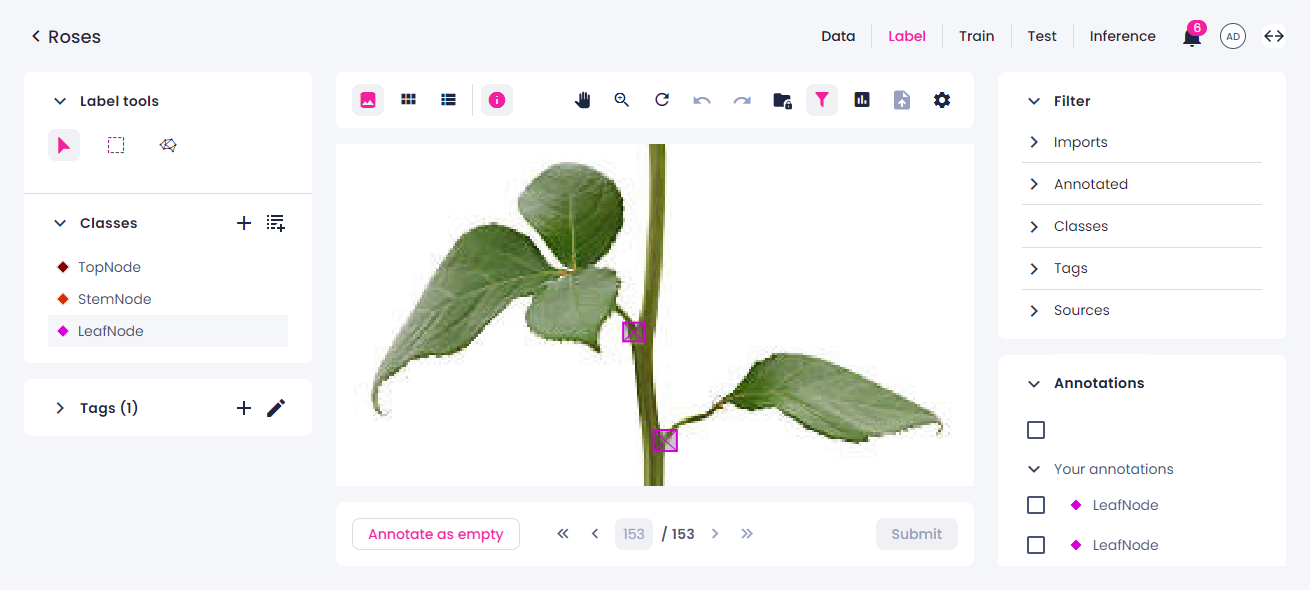
You can now easily review misaligned bounding boxes and align them using the Show center point setting.
-
You can now use filters and charts to generate predictions for specific samples.
Tags in test center
-
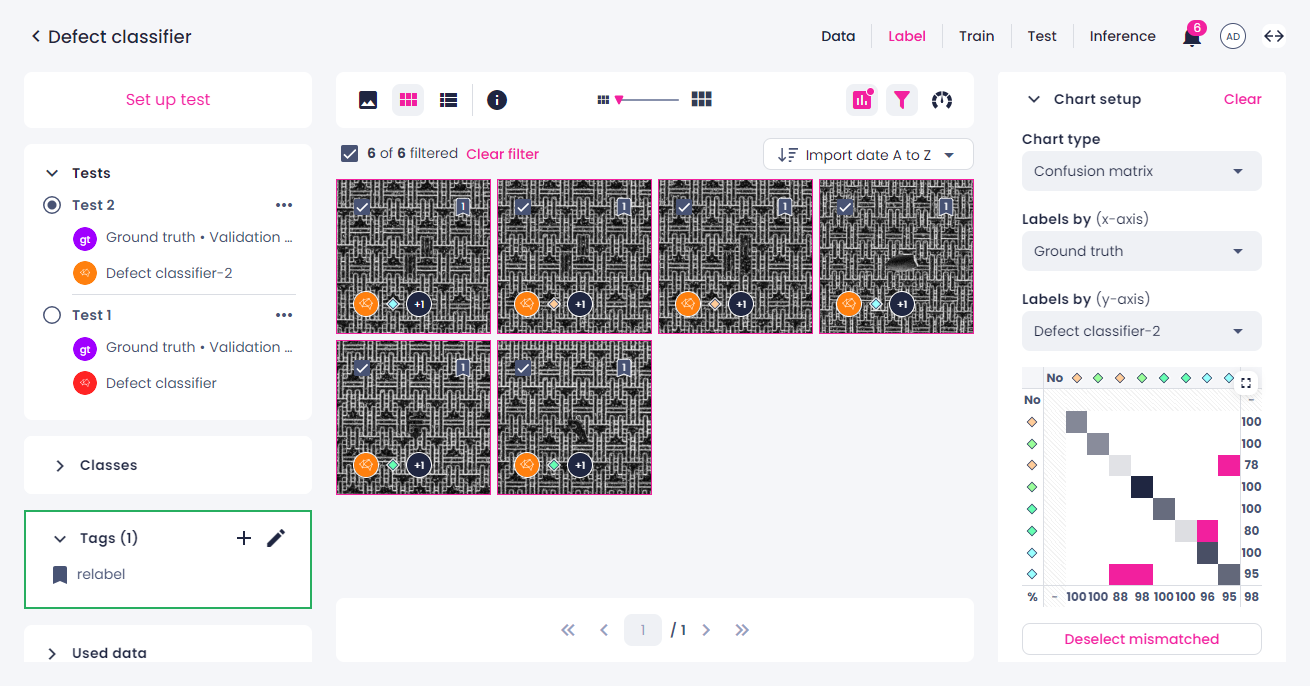
Tags can now be used to group data both in the label and test centers. Tags created in the label center can be used and managed in the test center, and vice versa.
Charts
-
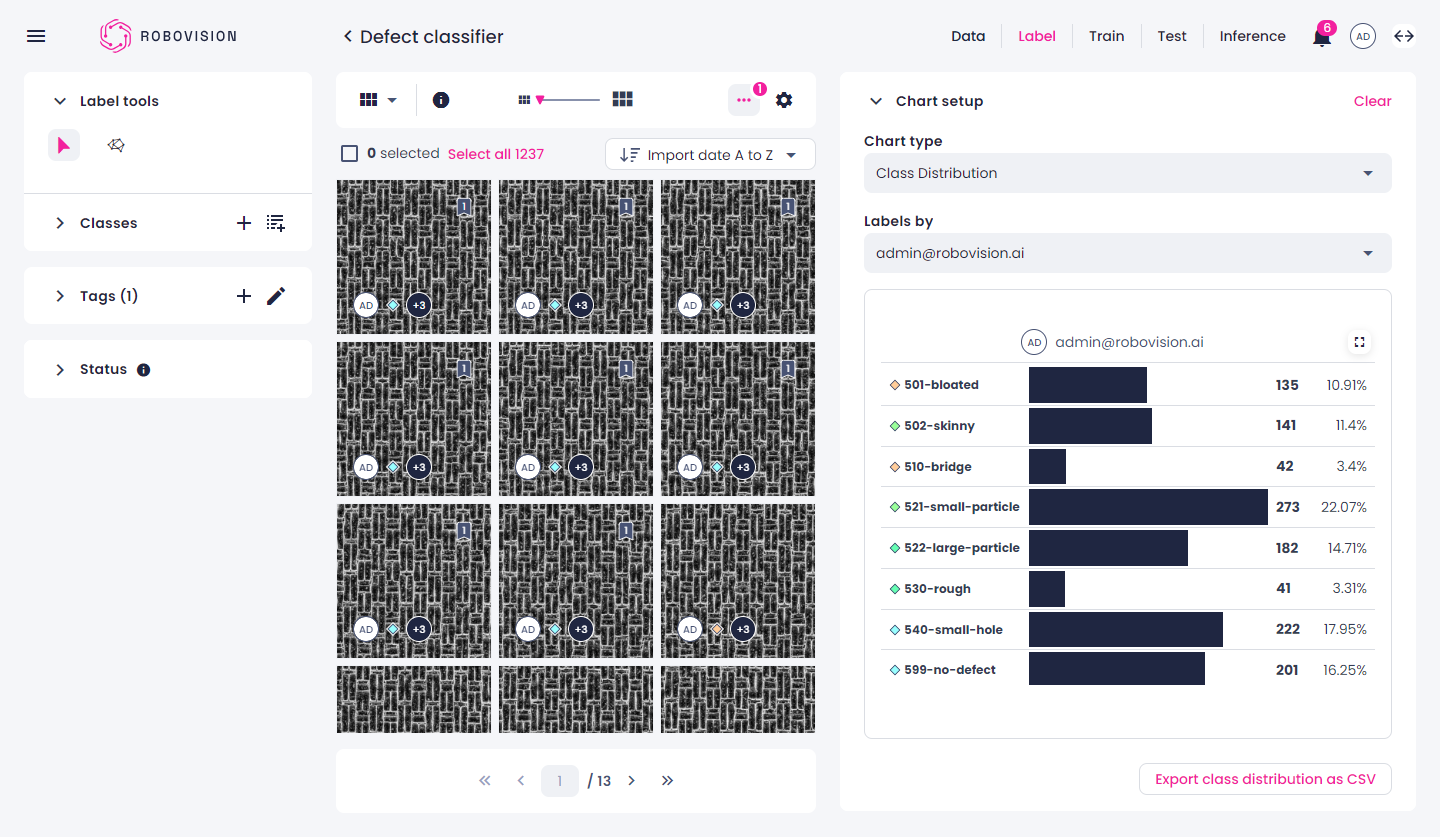
When working with charts and data filtering, you can now change the platform layout to the split-view mode.
-
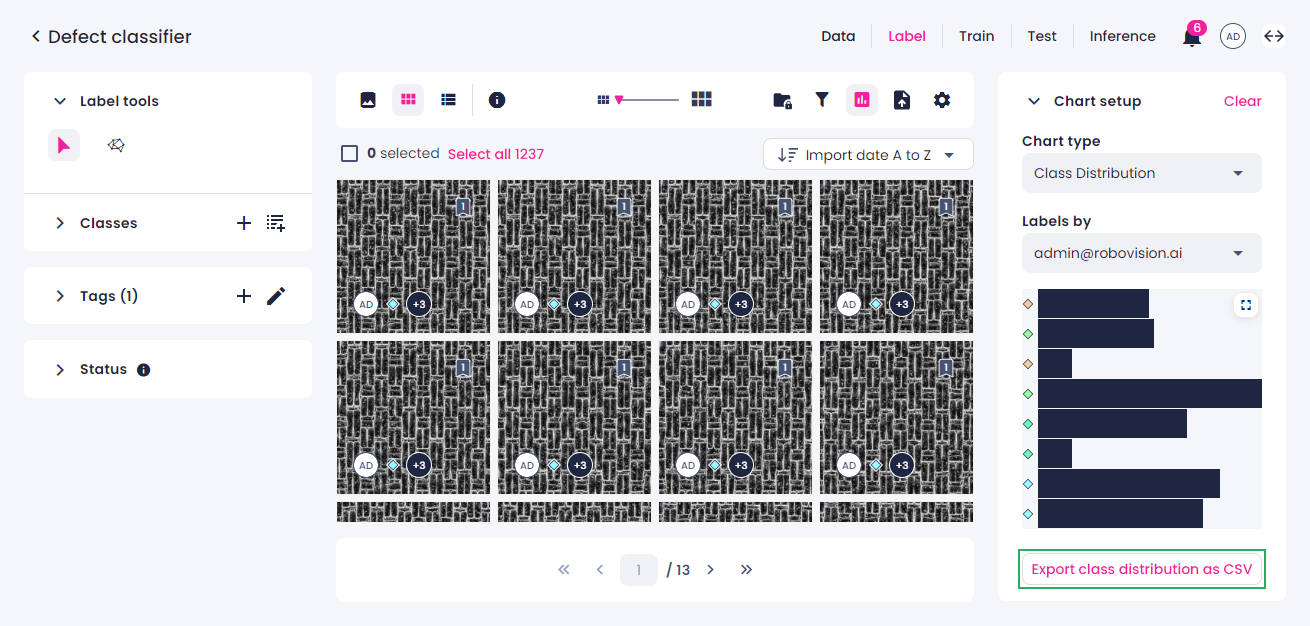
The class distribution and confusion matrix charts can now be exported to the CSV format.
-
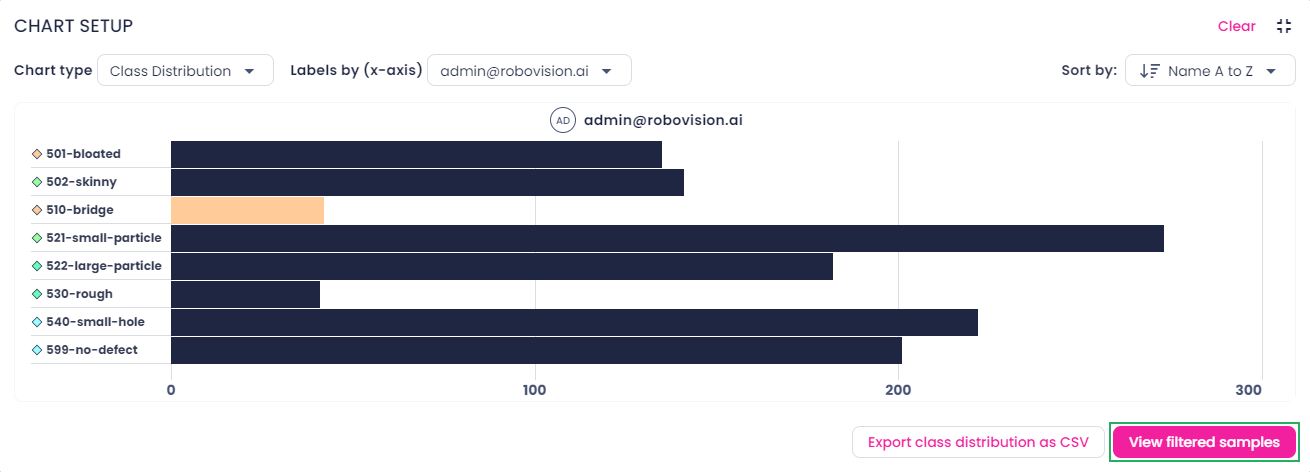
When a chart is maximized, you can return to the selected samples by clicking View filtered samples below the chart.
-
Confusion matrix:
-
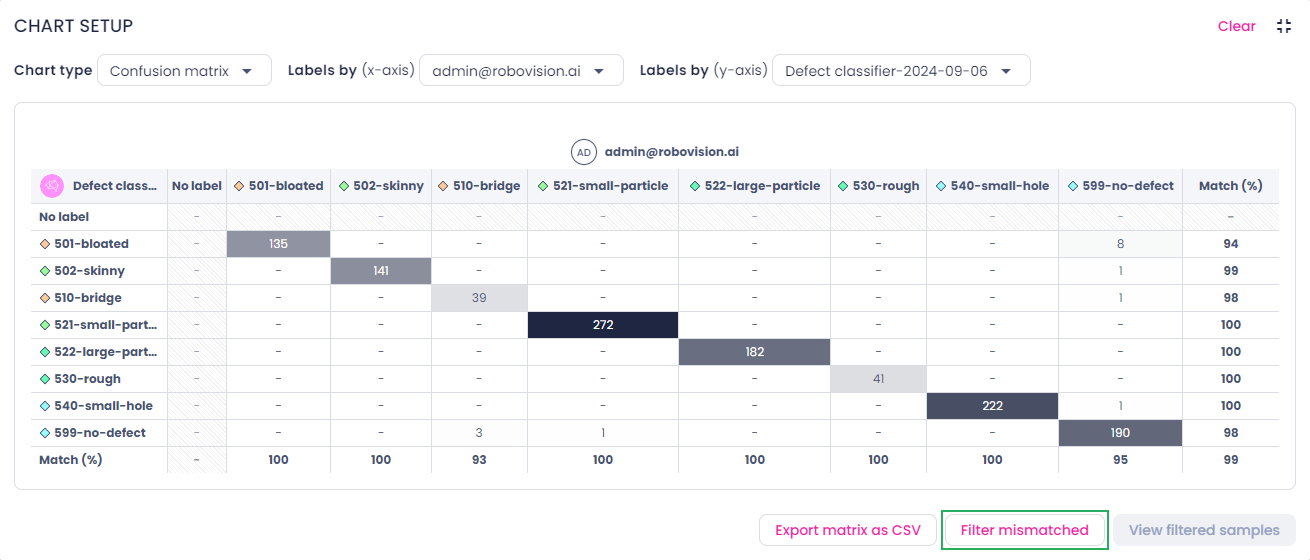
You can now filter all misclassified (off-diagonal) samples in the confusion matrix with a single click.
-
You can select multiple cells in the matrix by holding the Ctrl/Cmd key, and then selecting the necessary cells. This shortcut is only available when the matrix is minimized.
-
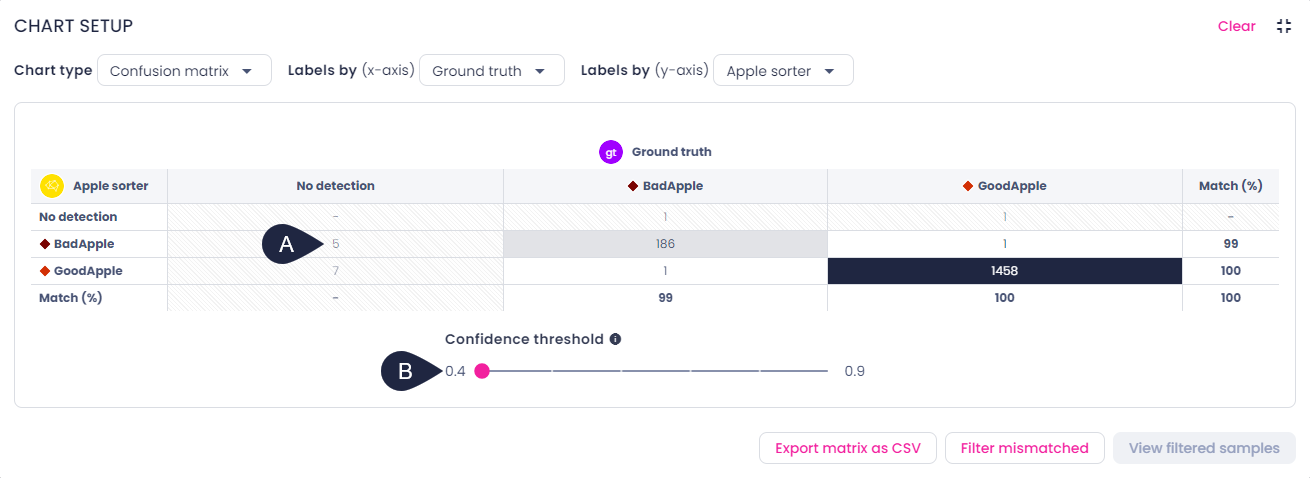
SOLOv2, YOLOv5: The Confusion matrix is now available in the test center:
- Each matrix cell displays the number of annotation pairs (two bounding boxes or two masks).
- You can track annotations without a pair (false positives, undetected objects) (A).
- You can view confusion matrices for different confidence thresholds (B).
-
Settings page
- All information related to the Robovision AI setup has been moved to the Settings page. You can use it to manage brand assets, installed algorithms, and platform-to-platform connection.
- You can now delete the algorithms that you no longer need on your platform and that aren't in use anymore. The projects that use the deleted algorithm version will have limitations: you won't be able to upload new data or start new processes (training, testing, inference, and more).
Branding and brand assets
- You can return to the default Robovision AI branding by resetting the brand assets.
EfficientNet with AI-ADC extension
- You can now update your KRF file with the latest information from the platform.
-
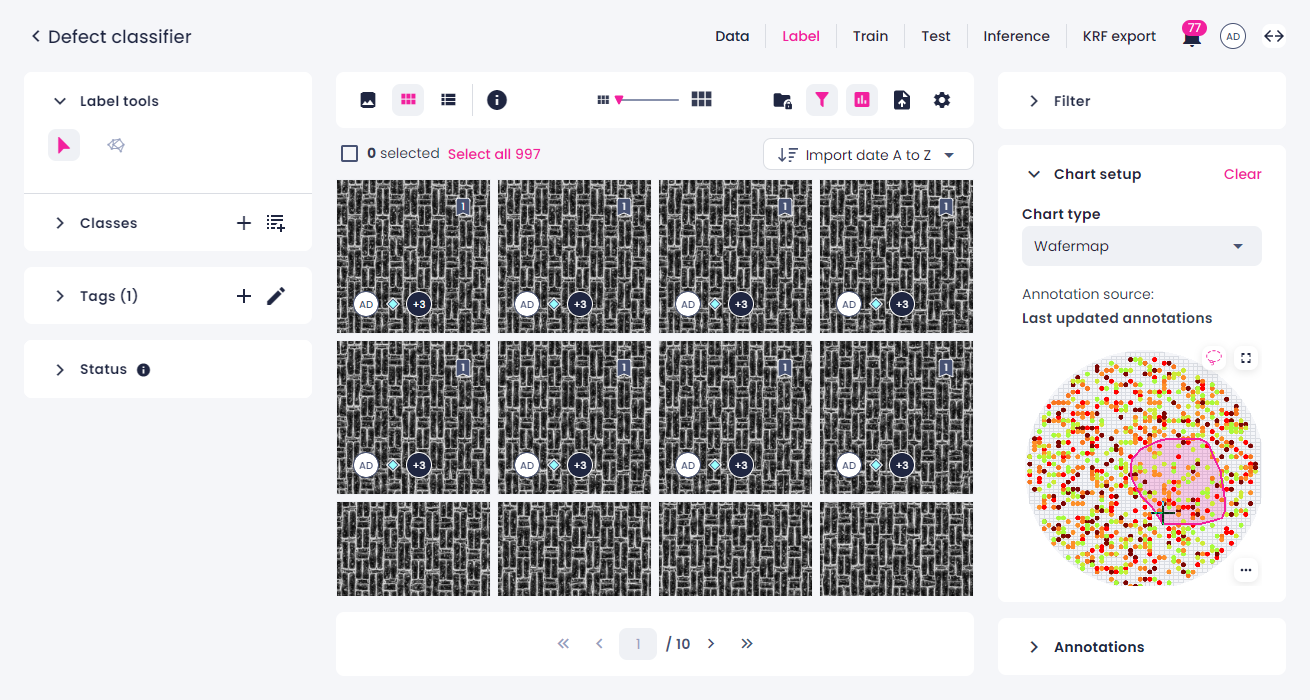
A new chart has been added in the label center—a wafer map. Now, you can select all samples belonging to a certain area by making a freehand selection on the wafer map.
Other improvements
- A new import format is now supported—KRF and data in ZIP. See Supported import formats.
- You can now import the exported Robovision AI samples into the project by dragging them onto the gray area of the Label center section.
-
Label center, test center, and the Datasets page:
-
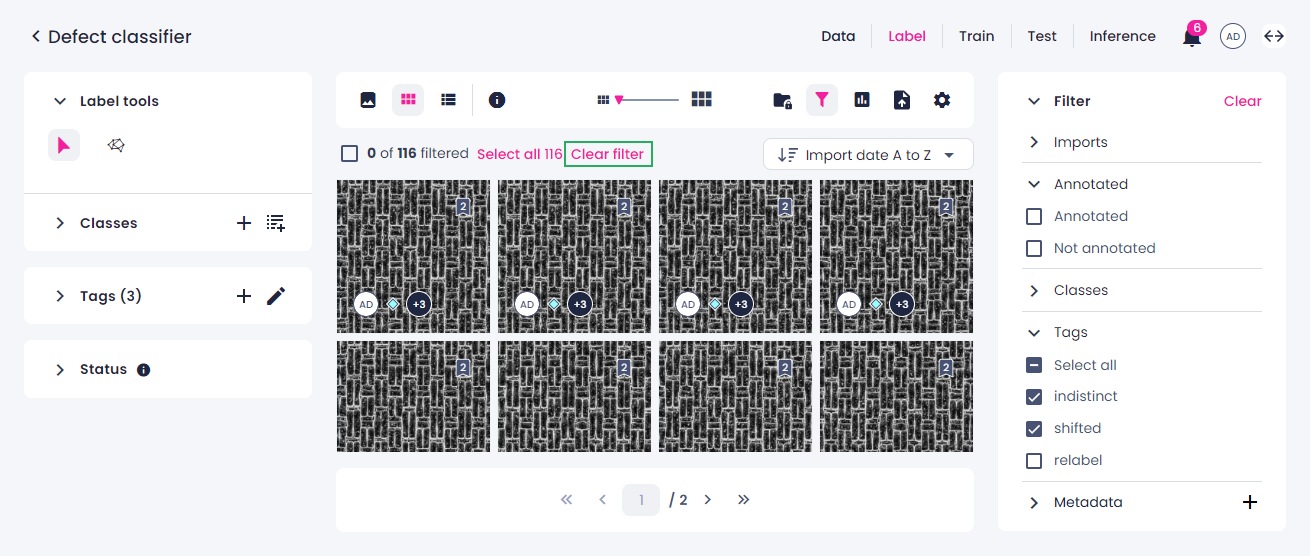
You can now clear all filters at once by clicking Clear filter above the samples preview or list.
-
Clicking an icon in the top navigation bar opens the corresponding panel on the right, and the view automatically scrolls to the newly activated panel.
-
API deprecation warning
-
The following methods are deprecated and will be removed in Robovision AI 5.9.
Deprecated Moved to datastore/api/v1/tags/{tag_id}/samples/batch-adddatastore/api/v1/tags/{tag_id}/samples/batch-pool-adddatastore/api/v1/tags/{tag_id}/samples/batch-deletedatastore/api/v1/tags/{tag_id}/samples/batch-pool-delete -
The following schemas were extended with the new functionality.
Schema Value IOJobTypeDATA_EXCHANGEOneOfIOJobDataoneOf {'$ref': '#/components/schemas/DataExchangeJobData'}BuildStateDELETEDDeploymentStatusSTOPPINGIJobDefinitiononeOf {'$ref': '#/components/schemas/RecordingJobDefinition'} -
The properties of the
DatapoolFiltershave been wrapped in afiltersargument.
Bug fixes
Label center
- Previously, when you filtered samples using the confusion matrix and then annotated them, all samples were annotated, not just the filtered ones. This issue is now fixed.
- The issue where some thumbnails were not displayed in the thumbnails view has been resolved.
- When you filter by a tag, and then unassign this tag from a sample, the number of filtered results now gets updated.
- Zooming and panning in the single view now works correctly.
- In the full-screen mode, the Add system classes button now works as expected.
- Previously, samples export could still continue after you clicked the stop button. This issue is now fixed.
- YOLOv5: When you add a few annotations, and then delete the last one, the Submit button now remains active.
Training center
- Validation set augmentation has been disabled for EfficientNet.
- Now, if the training process runs out of memory, an appropriate message is displayed.
- SOLOv2: If the validation dataset selected for a training includes only empty annotations, an improved error message is now displayed.
Test center
- Previously, tests on datasets with only empty annotations used to fail. This issue is now fixed—the test no longer fails, and its test score is set to N/A.
- YOLOv5: In some cases, a test could fail but appeared to keep running without progress. Now, you will receive a notification if a test fails.
Charts
- Class distribution (SOLOv2, label center): If you update annotations while the chart is open, you are now prompted to refresh the chart.
- Confusion matrix (test center): For tests with comparison, the confusion matrix is now open by default once the test process is over.
Robovision Edge
- During data import from Robovision Edge 5.6 to Robovision AI 5.7, samples are now correctly imported with their names. In earlier versions (5.5 and 5.6 respectively), sample names were missing.
Other bug fixes
- The model names are now displayed correctly when you select a model for transfer learning, model testing, and other tasks.
- Previously, when you edited an inference, it could show the shutdown time of another inference from the same project. This issue is now resolved.
- Long project names are now truncated if there is not enough space in the top navigation.
- Previously, the Label center section on the project details page incorrectly showed the number of samples as the number of imports. This issue has been fixed, and the correct number of imports is now displayed.
Known limitations
General
- The Robovision AI UI has been optimized for the browser size of 1920x1200.
- You will be logged out of the platform if your data import has been in the Uploading stage for more than an hour.
- If the storage is full, some functions may become unavailable, for example, saving annotation or training a model.
- When upgrading to a new version, new algorithm versions are installed, while preserving the existing ones. Existing projects will be updated to utilize the new algorithms.
- If the terms and conditions change, you will not be prompted to read and accept them again.
-
Notifications may be missing in specific cases, such as:
- When copying of annotations fails because the storage is almost full.
- When the connection between two Robovision AI platforms is lost during an ongoing samples transfer.
Browser support
- The Robovision AI platform has been designed and validated for Google Chrome 85 and Mozilla Firefox 77 or later.
- In Google Chrome, training metrics and a final validation score might not be displayed if an ad blocker is used. To prevent this, mark the Robovision AI URL as trusted in the Google Chrome settings.
- In Google Chrome, the thumbnail view can load slowly if you have password managers like Lastpass activated. To prevent this, disable the extension or work in a guest profile window.
- When using Google Chrome, you might experience issues in the label center. As a quick fix, reset your browser settings.
Backward compatibility
- Backward compatibility with Robovision AI versions 3.x and 4.x is not foreseen. But upon request, Robovision will provide the needed assistance and conversion scripts.
Images
- Types supported: In general and with respect to the model testing functionality, the following image types are supported: JPG, JPEG, PNG, 8-bit TIF and TIFF, BMP, GIF, including a 4th transparency channel. EXIF orientation metadata is supported.
- File names must contain only Latin (ASCII) characters. There are known rendering, packing, and backup/restore issues with file names/object keys that contain non-Latin characters.
Branding and brand assets
- Upon upgrading to a newer version, Robovision AI may include new UI text that has not been customized. To ensure alignment, export the template containing the UI text and review for any necessary updates (see step 3 in Change brand assets).
Label center
- 2D labeler performance (in particular the Magnetic lasso and Grab cut tools) may degrade for high-resolution images.
-
You may face the following issues when using the Prediction tool in the label center:
- The prediction process gets hidden if you leave the label center. To view it again, click the Prediction tool.
- The predicted labels are not added to the samples as the prediction process is running.
- The Status section is not updated as the prediction process is running.
-
If you select more than 100 samples in the label center, the Selected annotations panel on the right includes no information about individual samples. As a result, you will not be able to copy or delete individual annotations.
- When copying or replacing annotations for multiple samples, the same source should be selected for each sample (for example, annotations from one particular member or one prediction job).
-
- You can export samples between Robovision AI platforms only in Chromium-based browsers (Google Chrome, Microsoft Edge, and more).
- Exporting large numbers of samples to the connected platform may fail. To avoid this, export no more than 200,000 samples at a time.
- If you don't change the default name, all exports in your project will share the same name.
-
When creating tags in the Edit tags sidebar, it is possible to save a tag with the existing name using Enter.
- Label center setup: When you adjust the label opacity, sample brightness, or sample contrast, and then click Cancel, your changes will still be saved.
Pagination
- In all views except the single view, a maximum of 100 samples is displayed per page. If you select 1–100 samples within a page and then go to another page, these samples will no longer be selected.
- In the test center, you can't select samples beyond the current page (more than 100 samples). The same applies when you view samples in a dataset.
Classes
- It is possible to create a class with a name that is just a space.
Charts
-
Class distribution:
- Label and test centers: If you apply a filter when the chart is already open, the filter isn't considered. To refresh the chart, click Clear in the upper-right corner of the Chart setup panel, and then set up the chart again.
-
Confusion matrix:
-
Label center:
- If you apply a filter when the chart is already open, the filter isn't considered. To refresh the chart, click Clear in the upper-right corner of the Chart setup panel, and then set up the chart again.
- When you generate the chart for filtered data, some information in the chart might be inaccurate.
-
Test center:
- The chart doesn't consider the filters you have applied—the number and percentage of samples labeled with a certain class is incorrect. To view the actual number of samples, you'll need to click the needed cell.
- SOLOv2, YOLOv5: When a test compares two models or different parameters of the same model, more than one matrix may be generated.
-
Label and test centers: When setting up the confusion matrix, you can select the same user for both "Labels by (x-axis)" and "Labels by (y-axis)".
-
-
Wafer map:
- The wafer map chart is optimized for the browser size of 1920x1080 in full-screen mode. To enter full-screen mode, press F11.
- When the wafer map contains more than 100,000 samples, selection and filtering within the chart may affect performance and increase the loading time.
Training center
- During training setup, the Add model button is enabled even if there are no models available for transfer learning.
- When you stop and delete a training that had a custom name, the next training you set up will have the same custom name instead of the default one.
Test center
- If you test a model on tagged data without comparison, the test data in the test center may disappear after you unassign that tag.
- YOLOv5: If a test is set up with a confidence threshold of 0, it will automatically run with a threshold of 0.001 instead. This temporary workaround prevents the test from failing.
- The test process will not start if the test name contains exactly 255 characters.
Inference
- You can transfer inference setups between Robovision AI platforms only in Chromium-based browsers (Google Chrome, Microsoft Edge, and more).
- Imported models aren't displayed on the training details page and the Training center section of the project details page because trainings—not models—are shown there. However, you will still be able to select imported models for transfer learning, to set up a test, and more.
- If you try to stop the import of an inference setup, the process will still finish.
- The inference setup displays default values even when the parameters were previously modified but not saved.
- SOLOv2: During inference setup, you can set the inference parameters that are outside of the available range. Despite this, the inference will run with the parameters within the range.
Data upload from Robovision Edge or connected Robovision AI platform
- On the target Robovision AI platform, you won't receive notifications about data upload.
- On the project details page, you can't stop the data upload.
- If you delete an import while it's still in progress, some imported samples may not be deleted. These samples will appear in the label center, but they won't be associated with any import.
- When data upload is in progress, the number of samples displayed above the sample preview may be out of sync with the number shown in the Imports group of the Filter panel.
- If a user connected to the platform is deleted, the list of projects or inferences during data exchange will appear empty. However, the connection status on the Settings page will still display as active.