Project types (or algorithms)
Classification projects
Image classification (EfficientNet)
Image classification involves assigning a class to an entire image. The annotation type used is a label. Image classification is best suited for cases where you want to identify that there is a class in an image, but not where it is or any other particularities of this class.
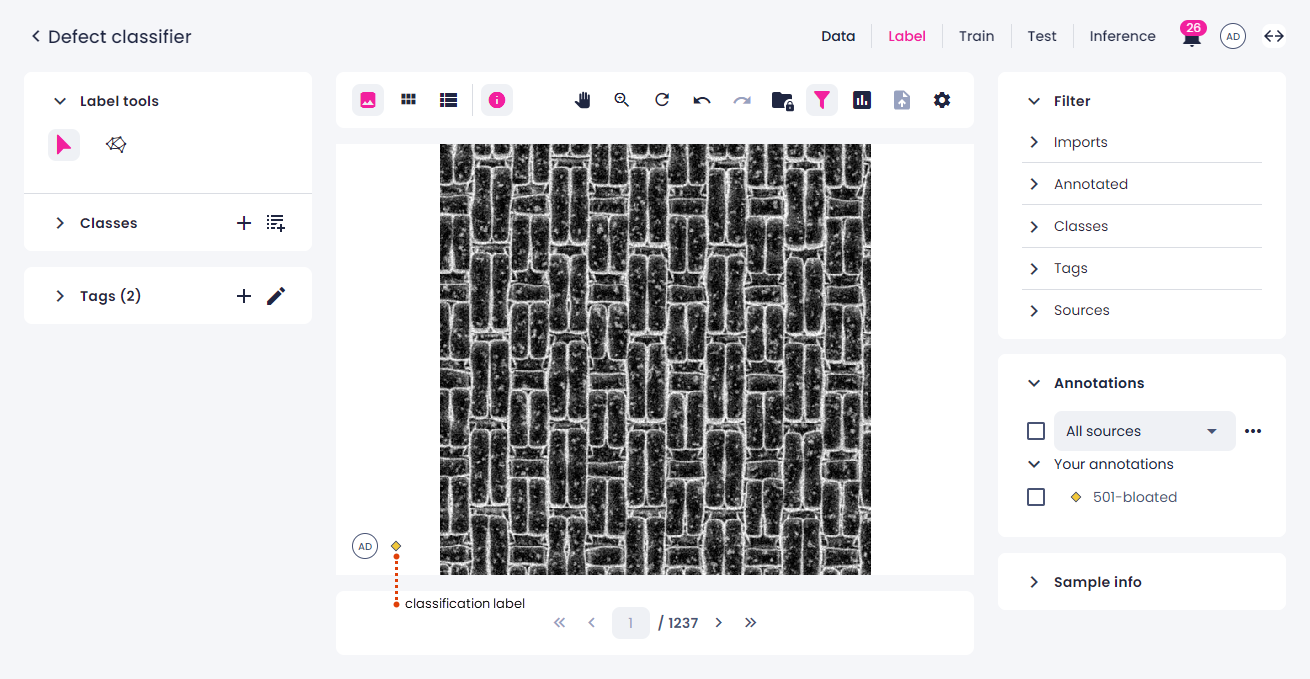
Image classification with wafer processing tools (AI-ADC EfficientNet)
Image classification on single images for the semiconductor industry. It includes KRF import and export, wafer maps, per-class threshold optimization and unknown rate monitoring. For a step-by-step tutorial, see AI-ADC solution.
Multilabel classification (MultiLabel EfficientNet)
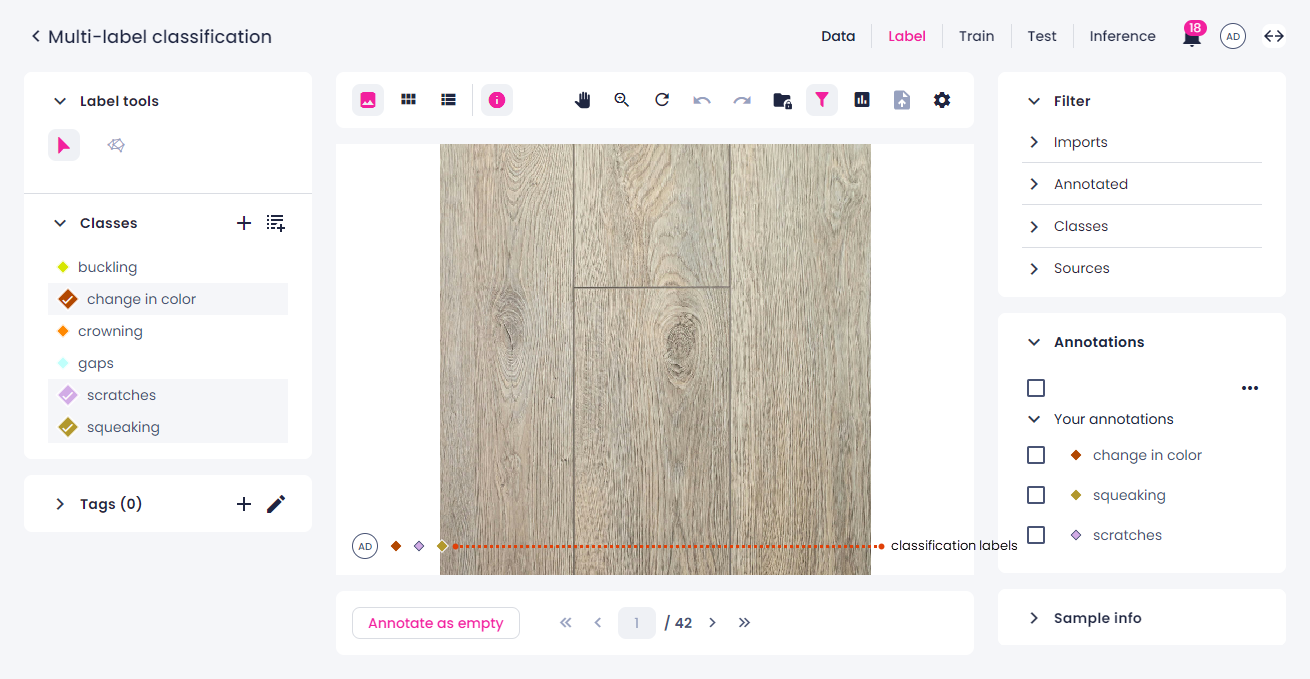
Multilabel classification involves assigning several classes to an entire image. The annotation type used is a label. Multilabel classification helps classify data by predicting any number of labels for a single image.
Detection projects
Object detection (YOLOv8+)
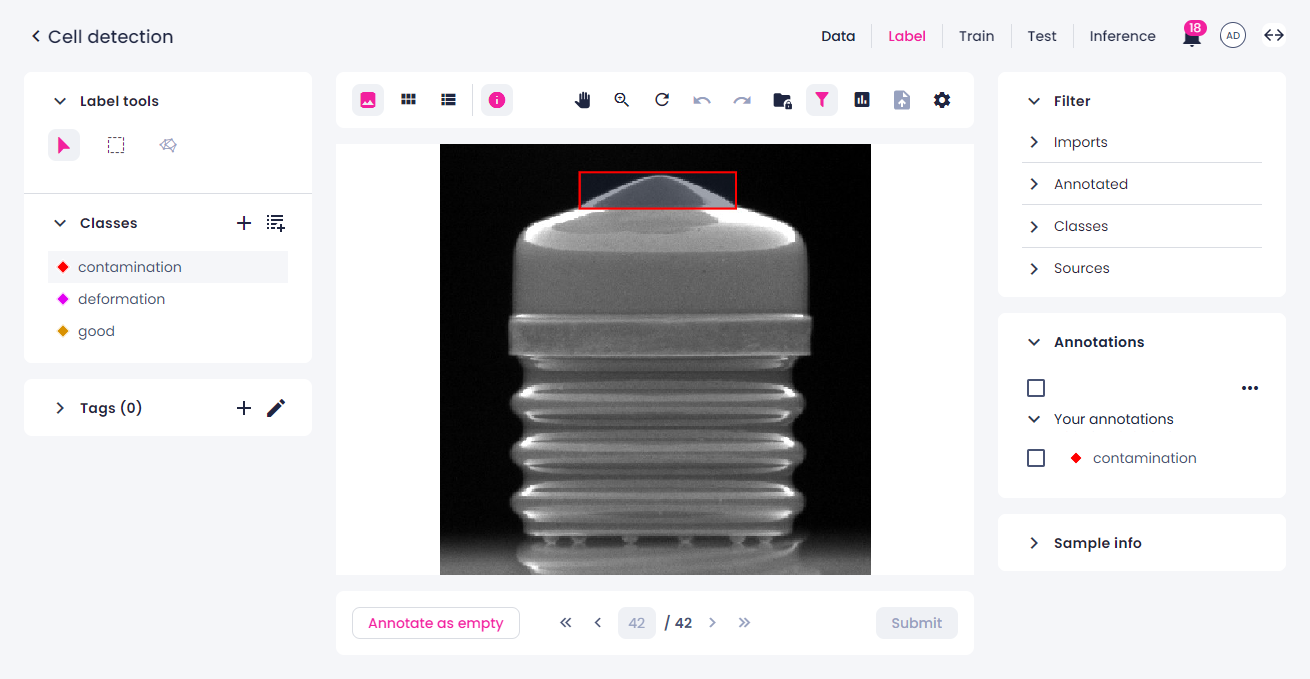
Object detection draws boxes around elements of a certain class. The annotation type used is a bounding box. Bounding boxes define both the presence and location of an object. Compared to image classification, object detection is a bit more complicated, because an image can have from zero to dozens of objects in them. This means that during inference, an object detection model can output more than one prediction for a single image.
Tip
YOLOv8+ is the standard algorithm for object detection. However, your Robovision AI instance may also include the YOLOv5 algorithm for backward compatibility. If you need help migrating your projects to YOLOv8+, contact our support team.
Segmentation projects
Instance segmentation (YOLOv8+)
Instance segmentation draws a detailed outline around elements of a certain class. The annotation type used is a mask. Masks define the exact shape of objects.
Instance segmentation is only required when you need to know the exact shape of each object and not merely where it's located or whether the object is present at all.
Tip
YOLOv8+ is the standard algorithm for instance segmentation. However, your Robovision AI instance may also include the SOLOv2 algorithm for backward compatibility. If you need help migrating your projects to YOLOv8+, contact our support team.
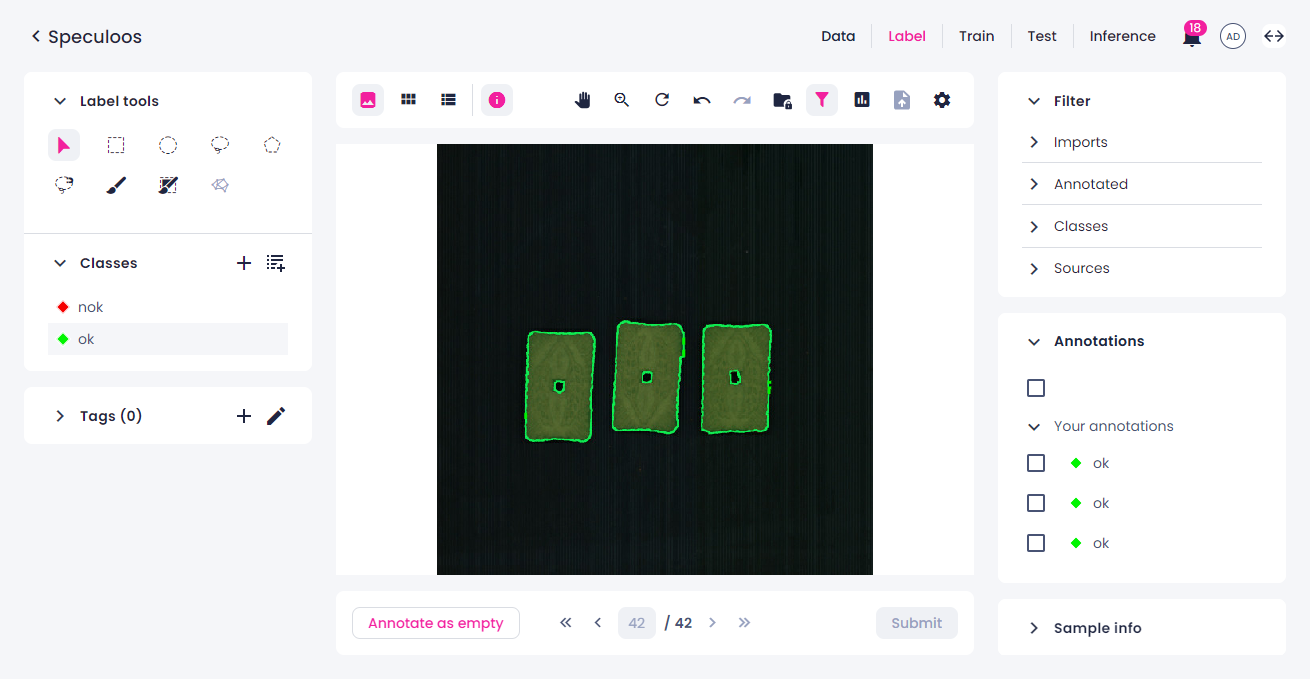
Semantic segmentation (PIDNet)
Semantic segmentation draws an outline around pixels of a certain class. This annotation type is called a mask. The labeling tools are identical to instance segmentation.
Semantic segmentation labels every pixel in an image by class, for example, all cars as car, while instance segmentation also distinguishes between different instances of the same class, for example, car 1 and car 2.
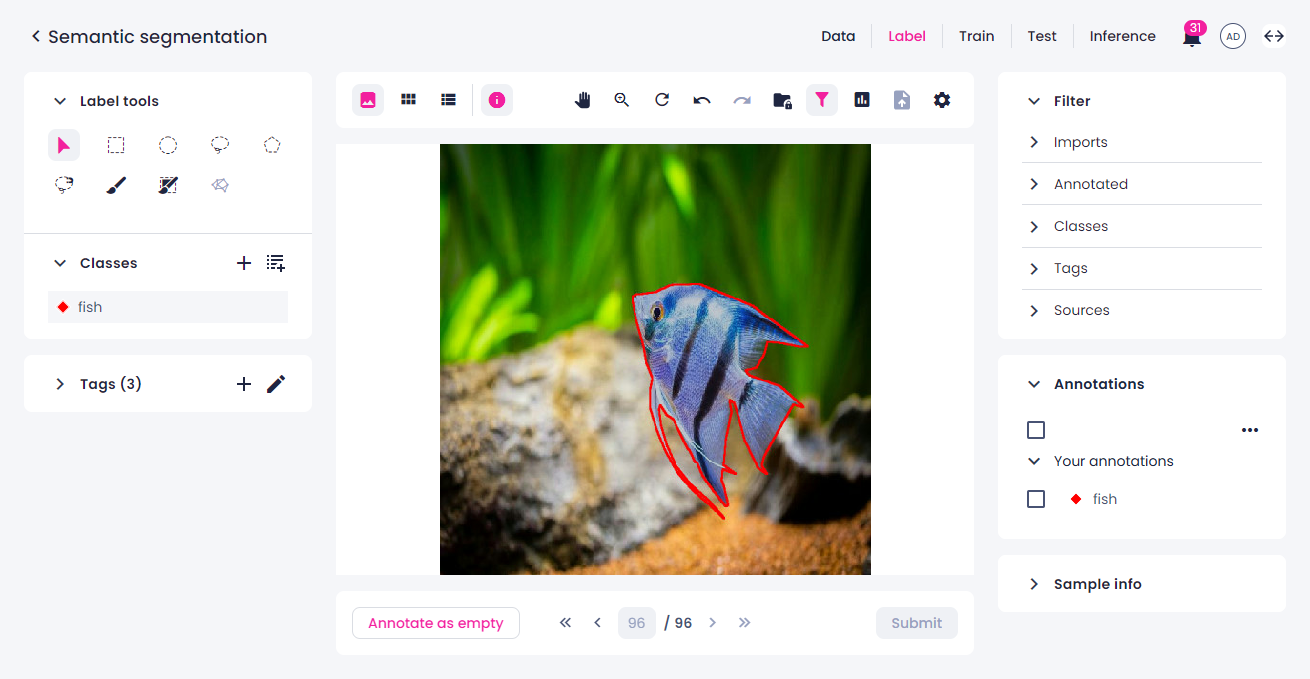
Ignore class
A special feature of our semantic segmentation implementation is the ignore class. An area labeled with a class called ignore, will be ignored by the model training. ignore must be written in all lowercase. Use this class to indicate areas you are not interested in. When you turn off the Use ignore class toggle in the training settings, the model will treat ignore like any other class.
Albumentations JSON
When augmentation is enabled in the training setup, you can provide augmentation settings using the Albumentations library in JSON format. Below is an example script illustrating the basic formatting.
{
    "__version__": "1.4.3",
    "transform": {
        "__class_fullname__": "Compose",
        "p": 1.0,
        "transforms": [
            {
                "__class_fullname__": "HorizontalFlip",
                "always_apply": false,
                "p": 0.5
            },
            {
                "__class_fullname__": "Rotate",
                "always_apply": false,
                "p": 0.5,
                "limit": 10
            }
        ],
        "bbox_params": null,
        "keypoint_params": null,
        "additional_targets": {},
        "is_check_shapes": true
    }
}
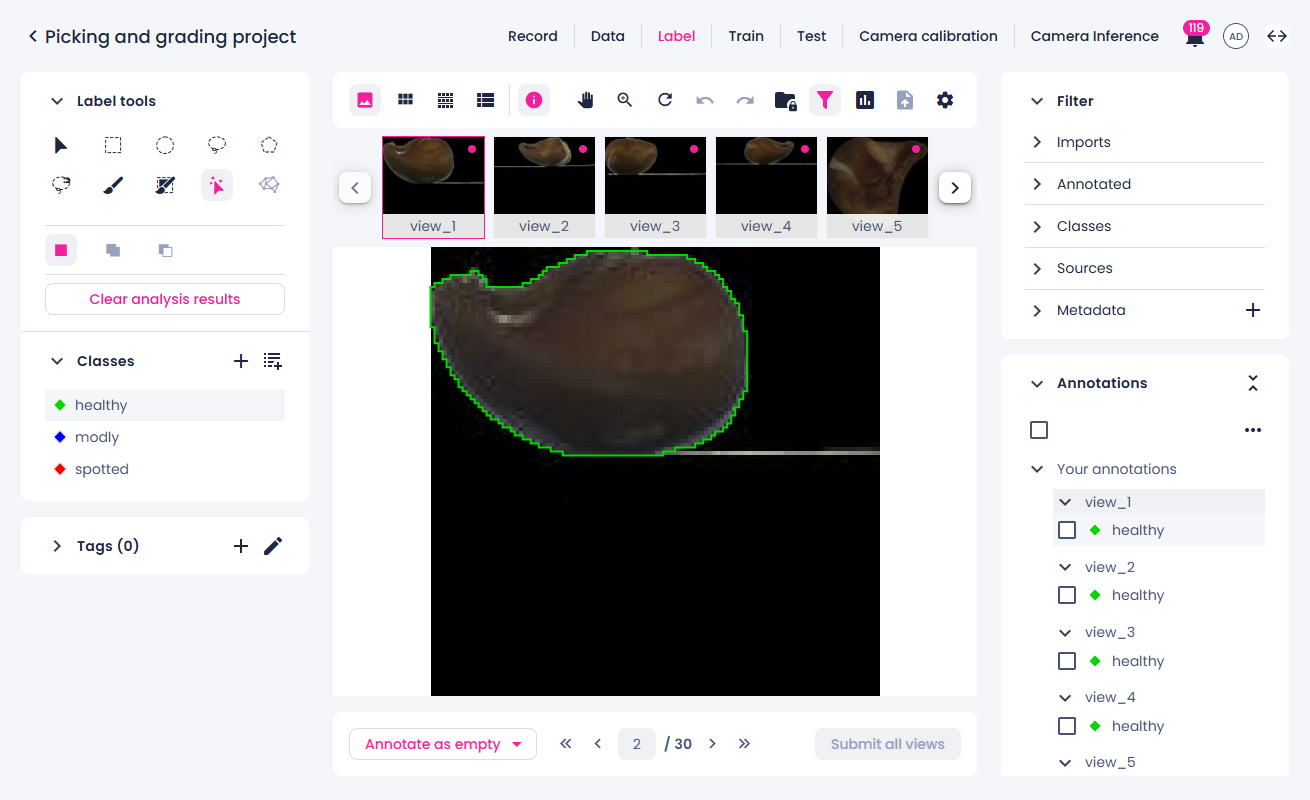
Multiview instance segmentation (Center picking and grading)
Multiview instance segmentation uses synchronized, calibrated cameras to locate object centers and ensure accurate picking or sorting across multiple viewpoints. Use this project type when precise localization, full object visibility, and consistent detection accuracy are required in dynamic environments such as conveyors or pallets.
The annotation type used is a mask. The Smart mask tool is the recommended tool for labeling, helping you define object boundaries efficiently and precisely across synchronized camera views. For a step-by-step tutorial, see Multiview center picking and grading solution.