
Label data
Once your data is recorded, it becomes available in the label center for labeling. In a DinoV3 few-shot segmentation project, you provide a small set of annotated reference examples that the model will use to learn the target objects or regions. Because the model learns from only a few annotated samples, it is important to maintain high-quality, representative masks across all selected examples.
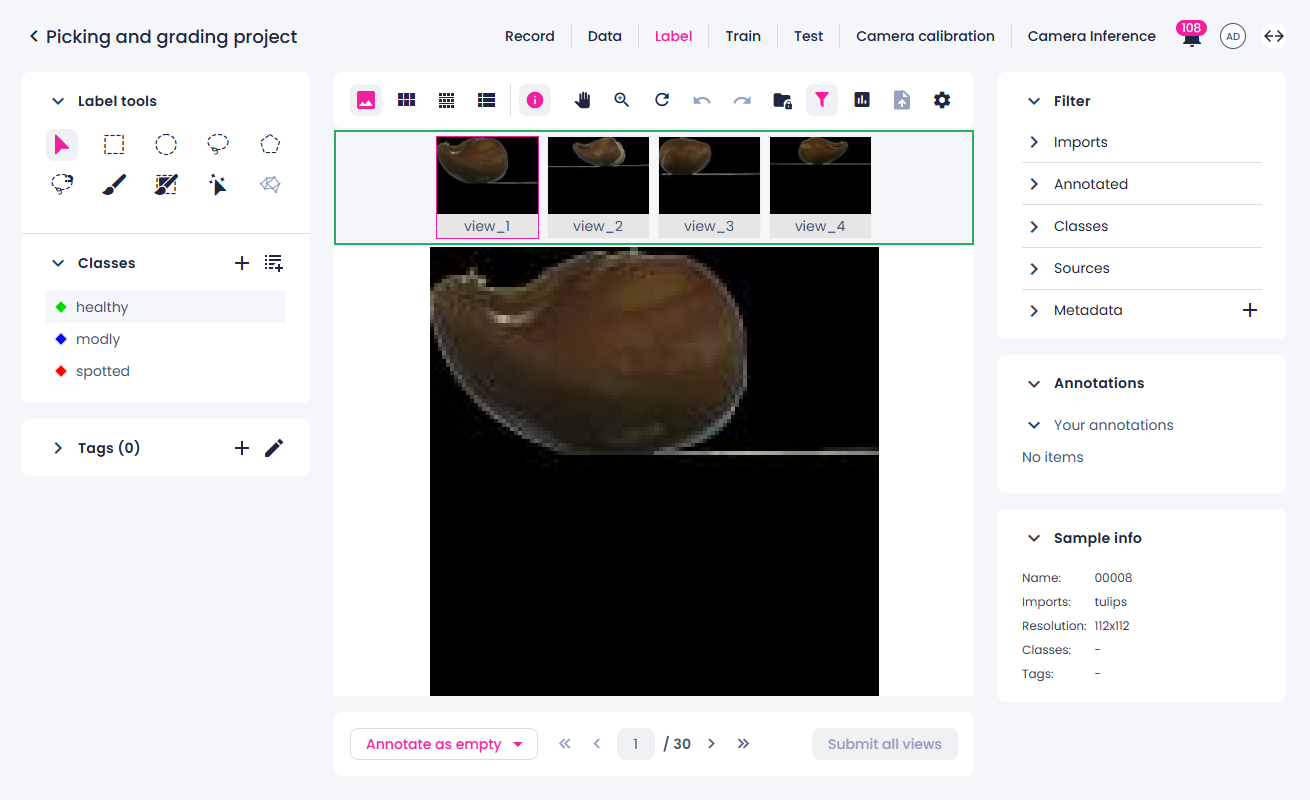
You can use a variety of tools to label your samples, such as Polygon, Brush, Smart mask, or others to create segmentation masks for each view. In this tutorial, we will use the Smart mask tool that enables you to perform one-click segmentation. Powered by the SAM (Segment Anything Model), it automatically refines and generates potential masks for a single image or for multiple (filtered or selected) images.
If a view doesn’t show the object, you can mark it as empty. When a view isn’t annotated, the system will prompt you to confirm whether it should be labeled as empty. This process ensures that each sample has a complete set of annotations—either a valid mask or an explicit empty annotation—across all views.
To label with Smart mask tool
- In the Projects module, select your picking and grading project.
-
In the Label center section, select the needed import or click the right-arrow button (
 ).
).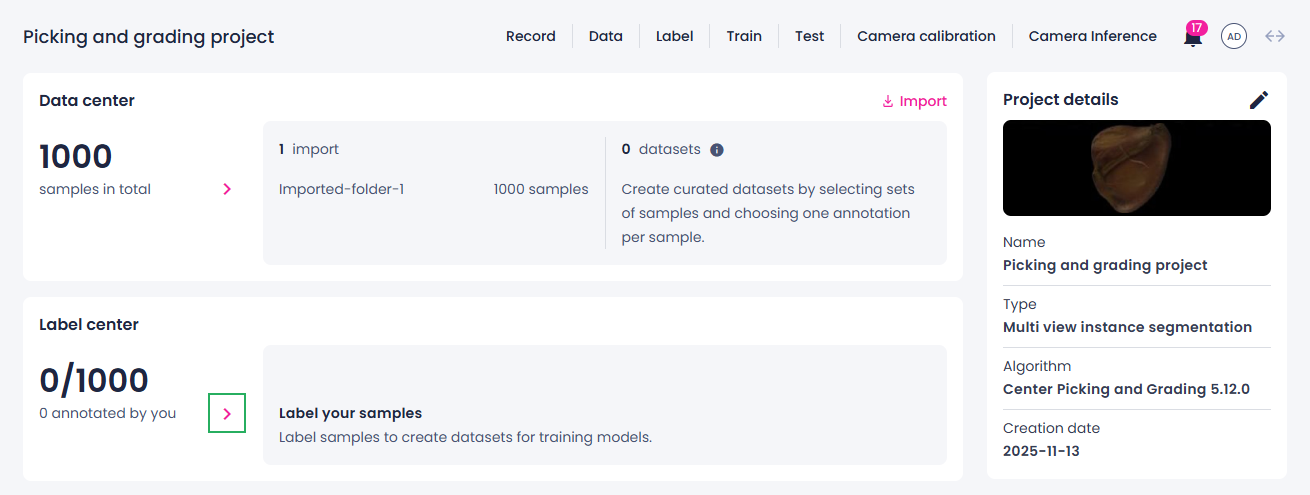
The data opens in the label center.
-
To add a new class:
-
In the left panel, in the Classes section, click Add first class or the plus button.
-
Enter the class name and press Enter.
-
-
To generate potential masks for multiple images, in the thumbnails or list view, select or filter the images for which you want to generate the masks.
-
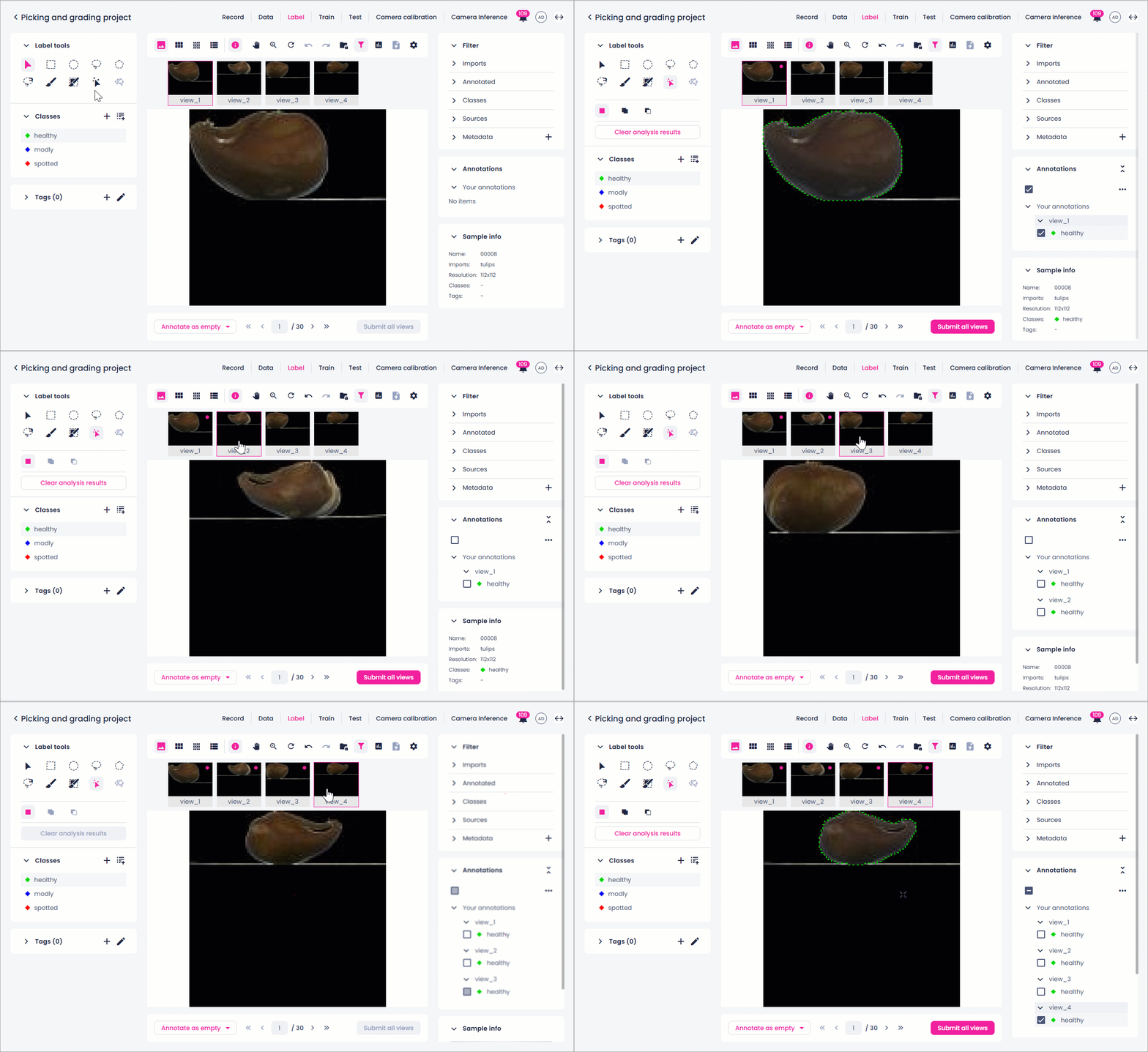
In the left panel, in the Label tools section, select the Smart mask tool.
-
To start analyzing the samples, select Analyze samples.
You can now track the progress of the analysis process.
-
To stop the analysis, click the stop button (
 ), and then, in the confirmation dialog, click Confirm.
 -
In the single view, hover over the image to preview the detected masks, and then click over the ones you want to save.
-
To adjust the selected element, do one of the following:
- To add to an existing annotation, select the necessary item using the Select tool. Select the necessary tool, click Add to item, and then make a new selection to intersect with the existing selection.
- To subtract from an existing item, select the necessary item using the Select tool. Select the necessary tool, click Cut from item, and then make a new selection to intersect with the existing selection.
-
To change the class of a selected label, in the Classes list, select the necessary class.
Your annotations are displayed in the Annotations panel on the right. Note that members with the Labeler role can view only their own annotations or annotations generated by the Prediction tool.
-
In the lower-right corner, click Submit all views.
Assign an empty annotation
-
In the single view:
- On the bottom toolbar, click Annotate as empty.
- Select if you want to annotate all views or selected view.
- Click Submit all views.
-
In the thumbnails, strip, or list view:
-
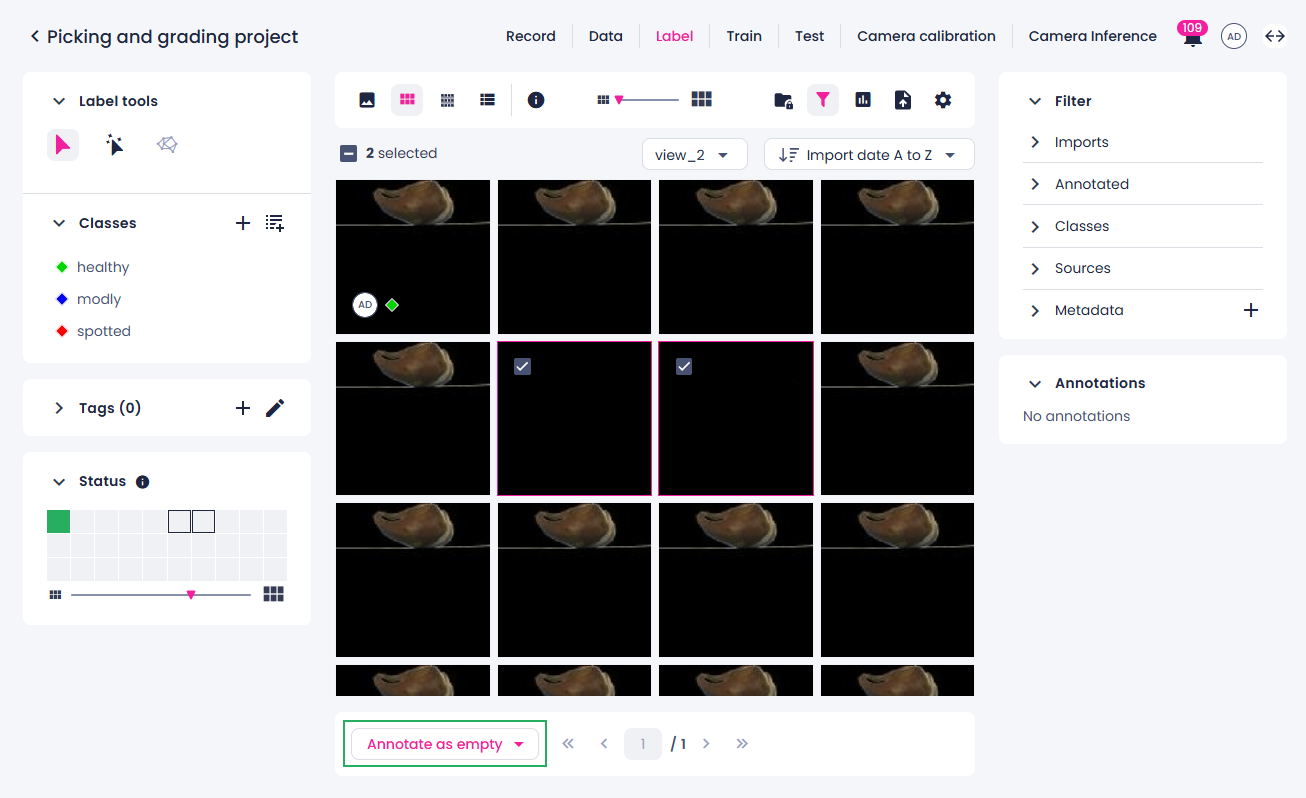
Select one or several samples.
Note
If you select samples and then go to another page, these samples will no longer be selected.
-
On the bottom toolbar, click Annotate as empty.
-
Select if you want to annotate all views or selected view.
- Click Submit all views.
-